

 Home
HomeWhy Are Aluminum Profile Surfaces Treated?
Aluminum has an interesting property — when a fresh aluminum surface comes into contact with air, it spontaneously and almost instantly forms a thin oxide layer that prevents further oxidation of the metal. This layer prevents deep corrosion of the metal. That is why aluminum is a metal with good corrosion resistance.
That sounds great. So why does aluminum surface treatment even exist?
This natural protection works reliably, but the spontaneously formed layer is uneven and very thin. The surface can therefore be blotchy or locally softer. For stable product properties in environments exposed to weather, sea salts, chemicals, or simply the passage of time — various forms of corrosion of this natural film can occur (pitting, crevices, stains, etc.).
This is where surface treatment comes into play — it increases the surface’s resistance to corrosion and generally improves surface properties, making it more uniform and durable. In addition, it allows virtually unlimited color options and responds to architects’ requirements.
Windows from Raw Aluminum — Is It Possible?
However, aluminum surface treatment is not a necessity. Over the years, we have encountered requests for the production of aluminum windows without surface treatment. Architects choose this option for art or industrial solutions. However, one must expect a raw appearance that is not 100% uniform across the entire material surface.
Aluminum Surface Treatment — Two Main Paths: Powder or Electrolysis
Powder Coating — A Synthetic Layer That Protects from the Outside
Powder coating means applying dry powder paint to an aluminum surface using an electrostatic charge and then curing it in an oven. During curing, the powder melts and forms a uniform, durable film that bonds with the aluminum substrate.
The process takes place in three steps:
- First comes pre-treatment — all unwanted substances are removed from the aluminum surface and the surface is prepared for painting. This step is very important for proper bonding of the paint layer to the aluminum surface.
- Then comes the actual painting, during which paint is sprayed onto the profiles using electrostatic guns
- Finally, the powder is cured — it polymerizes and stabilizes on the profile surface. This curing takes place in ovens at a temperature of around 200 °C.
The result is a thicker and more uniform protective layer — typically 60 to 120 microns — that resists UV radiation, rain, moisture, and temperature fluctuations.
Unlimited Color and Texture Options
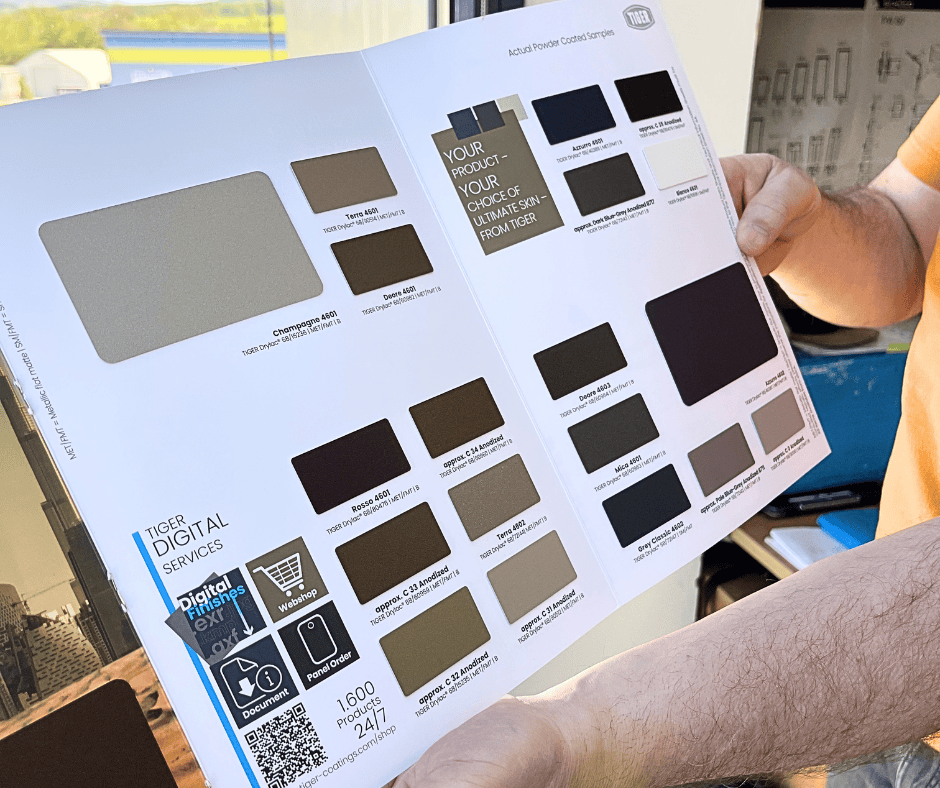
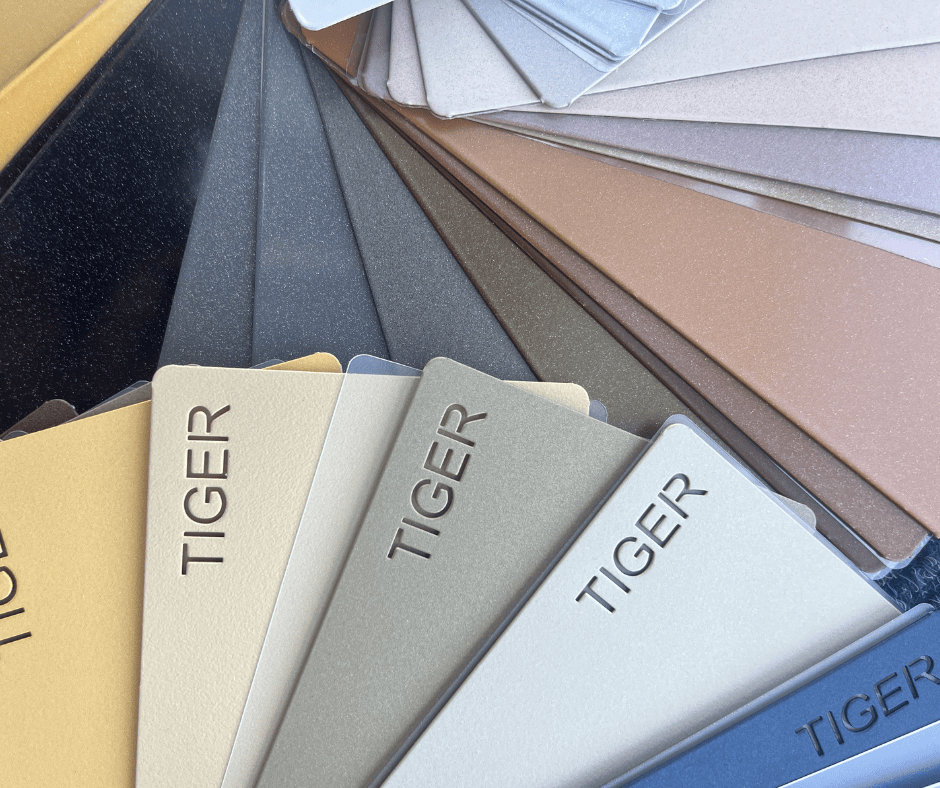
From an aesthetic standpoint, powder coating can be realized in practically any shade according to the RAL palette. Powder coating manufacturers offer enormous ranges of options:
- gloss coatings
- matte coatings
- semi-matte coatings
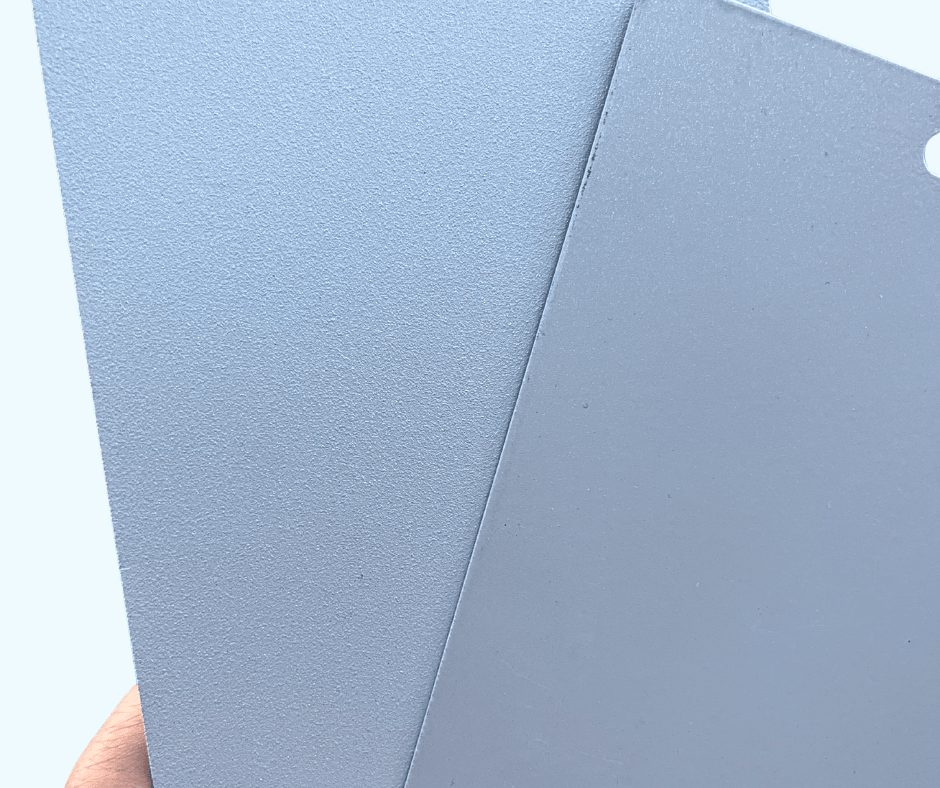
- textured (coarse texture, fine texture)
- metallics (finer, more pronounced)
TIP :) A nice website with accurate coating displays is, for example, TIGER
Anodizing (Anodic Oxidation) — Protection That Grows from the Metal Itself
Anodizing works on a completely different principle. Unlike coating, anodic oxidation does not create another layer of foreign material on the surface — the aluminum surface itself is converted into aluminum oxide. This layer prevents further corrosion and is many times more resistant to abrasion and scratching than the original material.
The basis of the process is the flow of direct current in an electrolyte solution. In this way, the natural thickness of the oxide layer can be increased up to a thousandfold, achieving high abrasion resistance and corrosion resistance.
Disadvantages of Anodizing
- very sensitive to alkaline solutions, which form stains on it (construction chemicals are alkaline – a complication during construction)
- more susceptible to scratching
- Unsuitable for large areas – uneven appearance
Anodizing and Colors — Preserved Metallic Appearance of the Material
Anodizing does not offer nearly as many color options as powder coating. It offers a few basic shades. The common feature is the preservation of the metallic appearance.
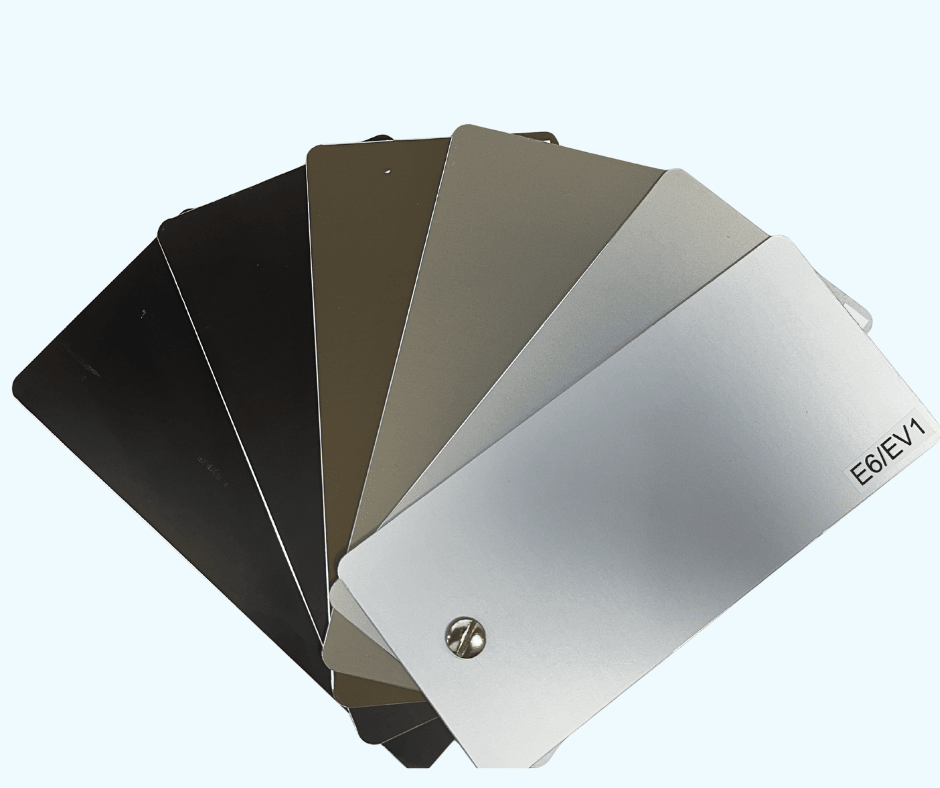
If color and texture are the priority, go with powder coating. If it is a surface where metallic appearance and long-term chemical resistance matter — anodizing is the right choice.
When Is Each Used — and Why Does It Matter?
Powder coating offers greater design flexibility — a wide palette of colors and surface textures. Anodizing, on the other hand, preserves the metallic appearance of the material, but with limited color range. From an architectural and construction perspective, powder coating is the dominant choice — worldwide it represents up to 85% of architectural aluminum profile production, with anodizing accounting for the remaining 15%.
The practical distinction is simple:
If color and texture are the priority, go with powder coating. If it is a surface where metallic appearance and long-term chemical resistance matter — anodizing is the right choice.
Not All Powders Are the Same: Durability Classes
Qualicoat
Defines performance classes of powder coatings according to their resistance to weathering — that is, the ability to maintain consistent color and gloss over time. In Slovakia, classes 1 and 2 are commonly available and used.
Class 1
Covers most standard orders — it is solid protection for normal outdoor conditions.
Class 2
Offers 3 to 5 times higher resistance to color and gloss degradation from solar radiation. In practice, this means longer color stability, better resistance to weathering, and extended surface life. The price difference compared to class 1 is not dramatic — and for more demanding projects or more exposed locations, class 2 is a sensible choice.
How Powder “Holds”: Surface Pre-Treatment
A very important step before applying the powder itself is surface cleaning. Any mechanical or chemical contaminants (dust, grease, etc.) will cause the paint film not to adhere sufficiently to the aluminum surface and may peel off or the metal under the film may corrode.
Therefore, pre-treatment always takes place before coating — a multi-stage process that prepares the surface. The surface is cleaned in several steps and by various methods (chemical degreasing, water spraying, ultrasound, sandblasting, grinding, etc.). Only on a perfectly cleaned surface can the paint be applied.
For Sea and Pools: Pre-Anodizing as an Additional Level of Protection
Standard pre-treatment is sufficient for most construction projects. However, in environments with the presence of salts — near the sea, near swimming pools, or in industrial zones — it is worth taking an extra step: pre-anodizing. Sea salt or pool disinfectants contain chloride salts, which can get under the paint film and cause corrosion of the aluminum there.
Pre-anodizing is actually anodizing used as pre-treatment under powder coating. It provides increased protection of aluminum against corrosion and also improves paint adhesion. The anodized surface is substantially more resistant to salts — whether sea salt or disinfectants from the pool. For this type of application, it is ideal to combine it with class 2 powder paint.
Conclusion: Surface Is Not Just Aesthetics — It Is Protection for Decades
When we choose aluminum windows or doors, most of the attention goes to color, texture, shade. That is natural. But this very article on surface treatments shows that behind what we see stands a whole series of decisions that determine how long the surface will look as it did on day one.
It is not the same whether it is class 1 or class 2 powder. It is not the same whether the coating shop does pre-treatment properly or not. And in construction near pools or close to the sea, it is definitely not the same whether someone thought about pre-anodizing.
Good surface treatment is not visible — it does its job quietly, year after year, without drawing attention to itself. And that is its greatest value.
When choosing, it is therefore worth asking: not only about the color from the RAL chart, but also about what powder is used, what the pre-treatment is, and whether the coating shop holds a Qualicoat certificate. These are questions that will not be met with surprise by a good supplier — quite the opposite.

You might be interested in